What Dewey Does
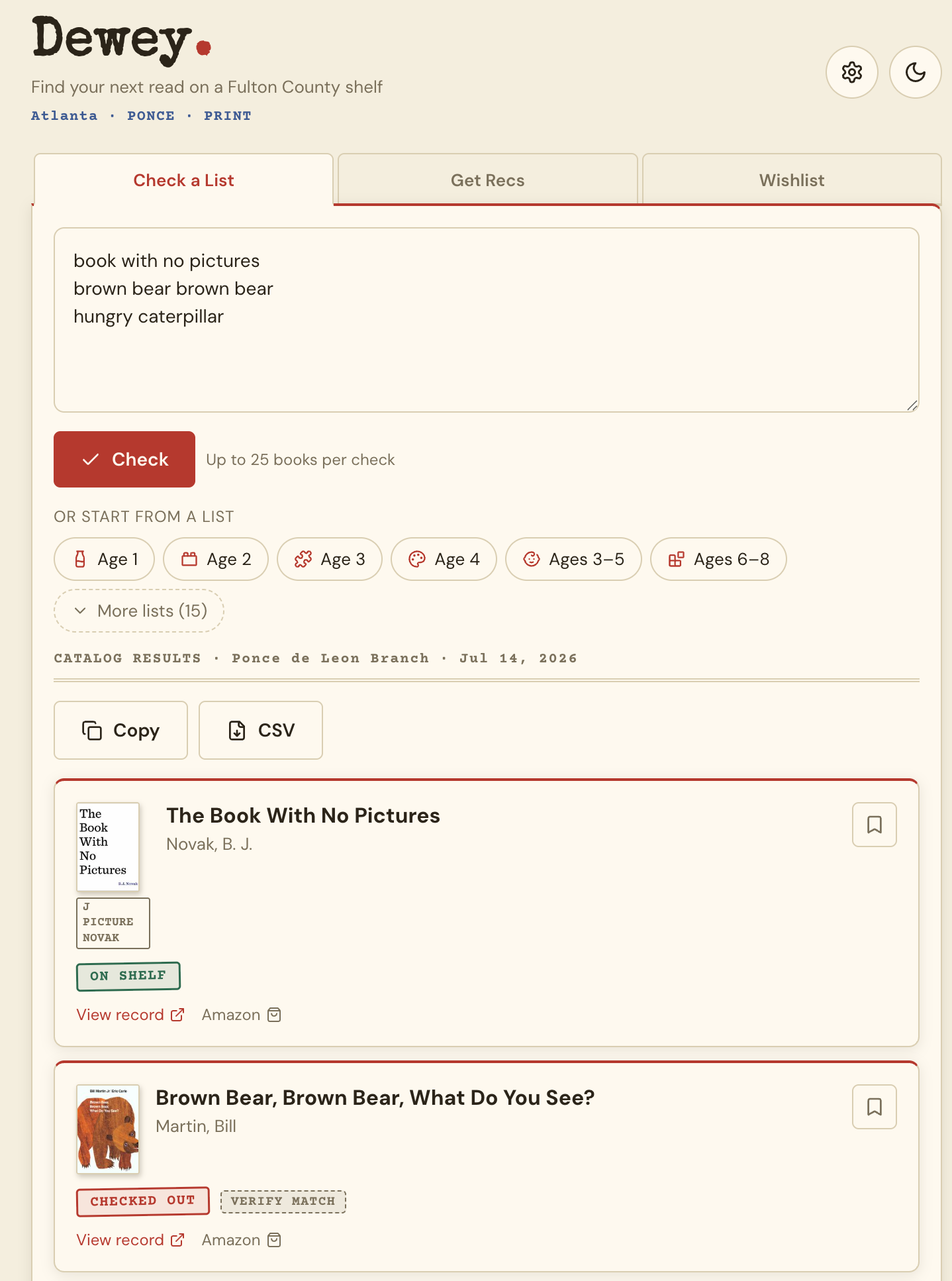
Dewey makes a library run concrete before you leave home. Paste a whole reading list—or ask for recommendations—pick a supported local branch, and it checks the live catalog in one pass. The result shows what is on the shelf, what is checked out, and the call number that gets you to the right aisle.
- Check a List — paste up to 25 titles or start with a built-in list.
- Get Recs — describe the kind of book you want, then check the recommendations at your branch.
- Wishlist — save books and recheck the whole list before the next trip.
Catalog support: Dewey currently supports the listed library systems using BiblioCommons, plus the DeKalb County Public Library Polaris catalog in beta (print titles only). View the public source on GitHub.
The model recommends. The library catalog verifies. If Dewey is unsure it found the right title or edition, it labels the uncertainty instead of pretending.
Why I Built It
Bedtime was getting repetitive, and I realized I wasn’t frustrated with reading—I was frustrated that I didn’t have the right books. Recommendations were easy. The painful part was checking every title against the library one search at a time.
One night I searched for funny bedtime books, found almost nothing available locally, went to the library anyway, and grabbed a book with an award-winning-looking cover. Halfway through bedtime I discovered it was The Cat Man of Aleppo—a worthwhile true story set during the Syrian Civil War, and profoundly different from the silly bedtime experience I thought I was bringing home.
That was the trigger. The missing feature was bulk search: check the whole list, see what is actually on the shelf, and stop gambling on a library trip.
The First Library Run
The first real test came before a trip: I checked availability for a list of Mexico books, walked into the branch with call numbers, and went straight to the shelves. The whole pickup took about four minutes. Jesse joked that I looked like I worked at the library.
So far, Dewey has been used for two library runs, with another list in progress. There is no formal time-savings measurement. The useful change is confidence: I am more likely to stop at the library because I know what is there and where to walk.
How It Avoids Confident Wrong Answers
Fulton County’s catalog runs on BiblioCommons. It has no public API, but its front end talks to an undocumented JSON gateway. Finding a reliable path through it took some scar tissue:
- A catalog format filter that should restrict results to books returns zero for valid searches, so Dewey filters the results itself.
- Fuzzy title search can broaden a miss into an unrelated hit. Dewey uses title-similarity checks and a VERIFY MATCH stamp for uncertain results.
- Author matching is often more reliable than ISBN matching because catalog records group multiple editions together.
The design principle is simple: label uncertainty instead of hiding it. A wrong “on shelf” answer costs a trip; a flagged result costs one click.
Why “Dewey”
He finds things in libraries.
What Problem Should We Try Next?
The best small tools often begin as one stubborn, specific annoyance. If you have one, I would love to hear it.